"GS1 Digital Link turns the package into a bridge between the physical product and the digital world. Norwix provides the printing technology that helps put that bridge on the package clearly, reliably, and at industrial speed."
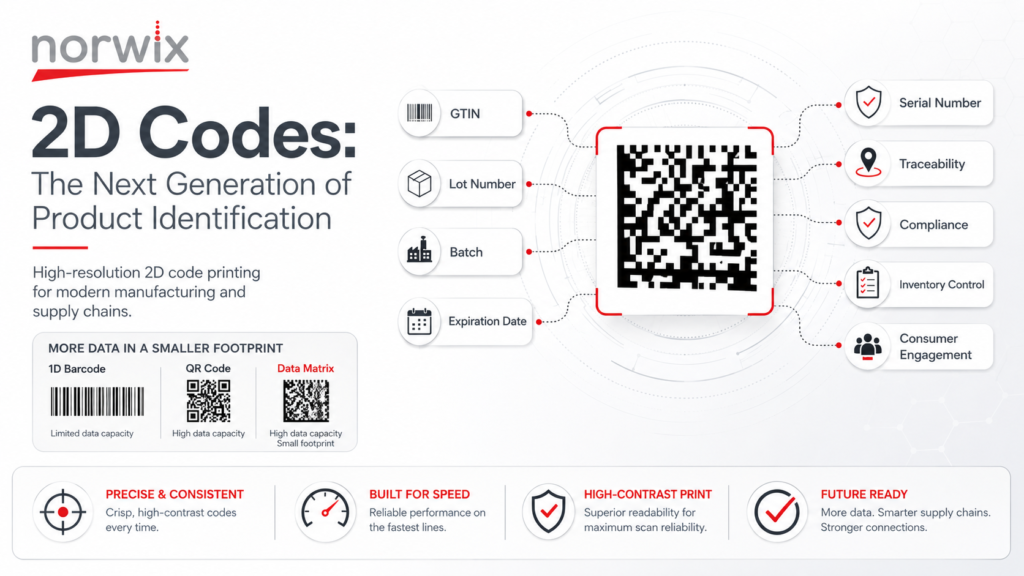
2D Codes: The Next Generation of Product Identification
2D codes are changing what manufacturers, brands, and supply chains can do with a single printed mark. Unlike a traditional 1D barcode, which is primarily designed to carry a product identifier for price lookup or basic tracking, a 2D code can hold significantly more information in a much smaller space. QR codes, Data Matrix codes, and GS1 DataMatrix symbols can be used to encode product data such as GTIN, lot number, batch number, expiration date, serial number, manufacturing details, and other variable information that supports traceability, compliance, inventory control, and consumer engagement.
For industrial packaging and product identification, this matters because the code is no longer just a checkout tool. It becomes a data carrier that can move with the product through manufacturing, distribution, retail, and post-purchase consumer interaction. A single 2D code can help support recall readiness, lot-level tracking, authentication, serialization, product transparency, and access to digital content. As supply chains become more data-driven, the quality and reliability of the printed code becomes just as important as the data behind it.
Sunrise 2027: Why the Barcode Is Evolving
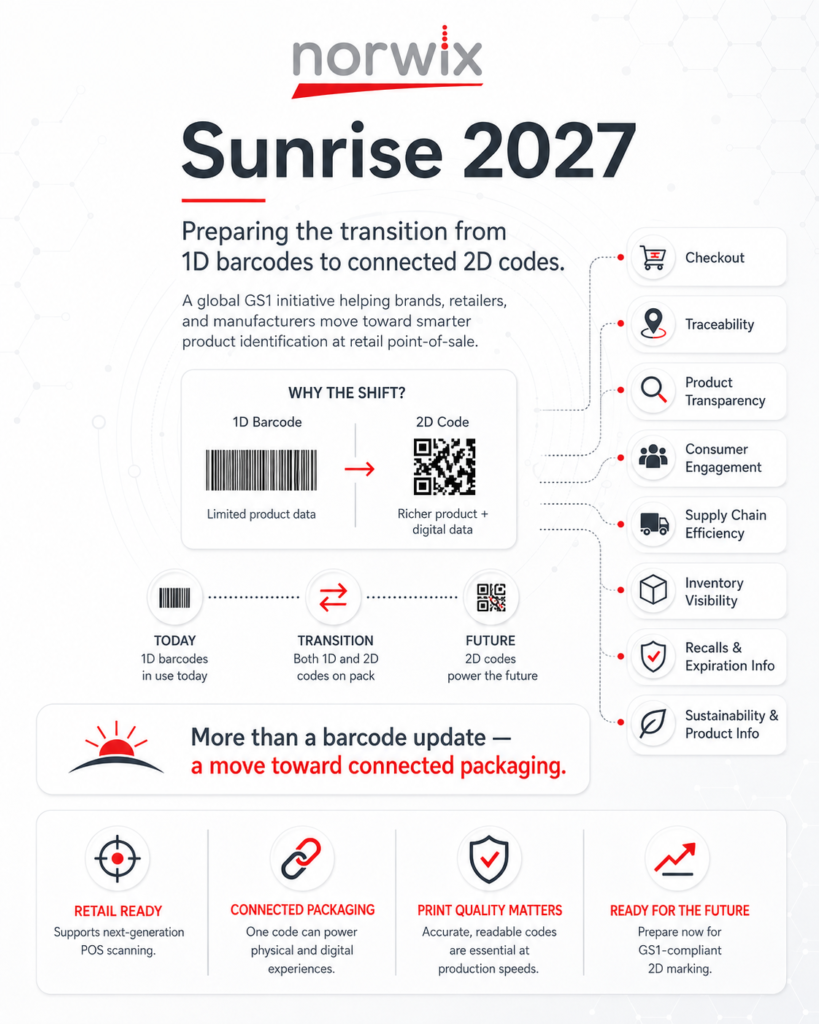
Sunrise 2027 is the global industry initiative led by GS1 to prepare retailers, brands, and supply chains for the transition from traditional 1D UPC/EAN barcodes to more capable 2D barcodes at retail point-of-sale. The goal is not simply to replace one barcode with another. The goal is to enable a smarter, more connected barcode that can support checkout, traceability, product transparency, consumer engagement, and supply chain efficiency from a single standardized code.
This transition is being driven by a simple reality: today’s products need to carry more information than a traditional barcode was designed to hold. Retailers want better inventory visibility. Brands want stronger consumer engagement. Regulators and supply chain partners want more transparency. Consumers want access to information such as ingredients, allergens, sourcing, sustainability, usage instructions, recalls, and expiration details. A 2D code can help connect all of these needs through one compact symbol.
For manufacturers, Sunrise 2027 creates a practical packaging and production challenge: the code on the package must be accurate, scannable, and printed consistently at real production speeds. During the transition period, many products may carry both a traditional UPC and a 2D code. Over time, the 2D code is expected to take on more of the work because it can support both product identification and richer data use cases. That means printing systems need to be ready now.
Sunrise 2027 is more than a standards update. It is a shift toward connected packaging. Norwix is positioned to help manufacturers make that shift confidently, with printers that can support today’s coding requirements while preparing production lines for the future of GS1-compliant 2D marking.
GS1 Digital Link: Connecting the Printed Code to Digital Product Information
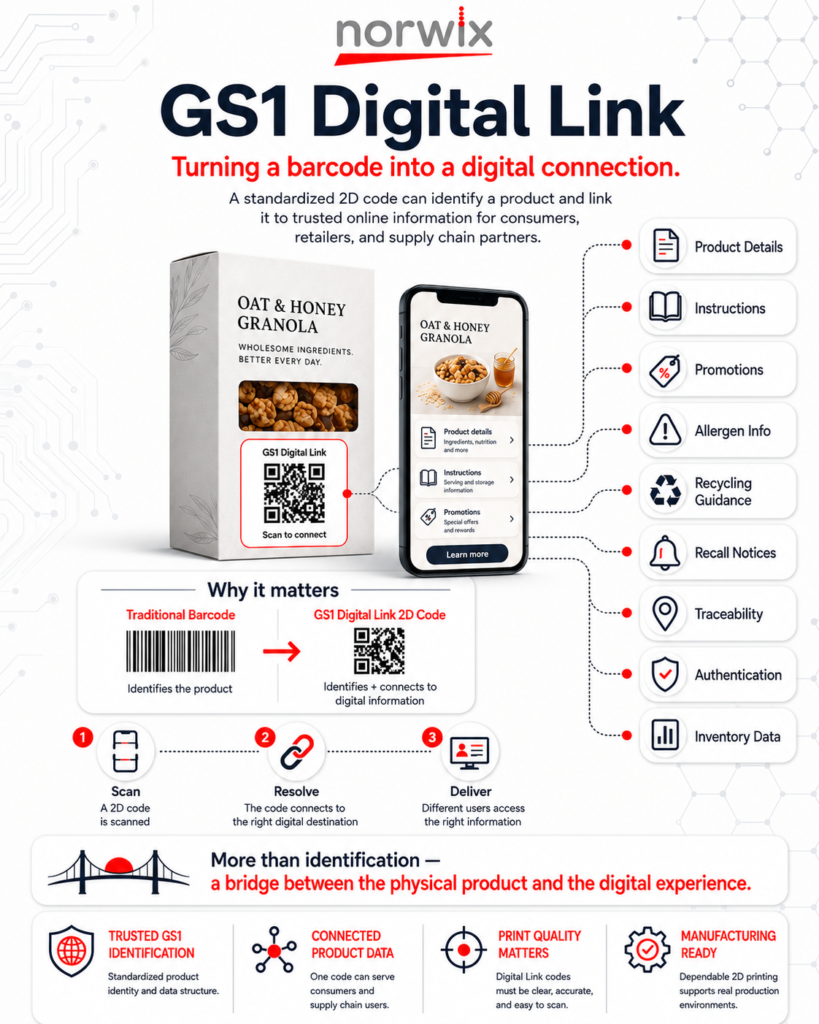
GS1 Digital Link is the standard that allows a barcode to function like a web link while still carrying trusted GS1 product identification. In practical terms, it gives brands a way to connect a physical product to online information using a standardized 2D code. When scanned, the code can direct different users to different types of information: a consumer may see product details, instructions, promotions, allergen information, recycling guidance, or recall notices, while a retailer or supply chain partner may access traceability, authentication, or inventory-related data.
This is one of the most important parts of the 2D code transition. A traditional barcode identifies a product. A GS1 Digital Link-enabled 2D code can identify the product and connect that identity to a broader digital experience. That creates opportunities for brands to reduce packaging clutter, improve transparency, support regulatory and retailer requirements, and keep product information current without changing the physical package every time online content is updated.
For manufacturers, the printing challenge is straightforward but critical: the GS1 Digital Link code must be printed clearly, accurately, and consistently. Every code must scan properly. Every variable element must be correct. Every mark must hold up to the realities of the production environment, substrate, line speed, and downstream handling. As more brands move toward Digital Link-enabled QR codes and Data Matrix codes, dependable industrial printing becomes a key part of the implementation strategy.
UDI Requirements for Medical Devices
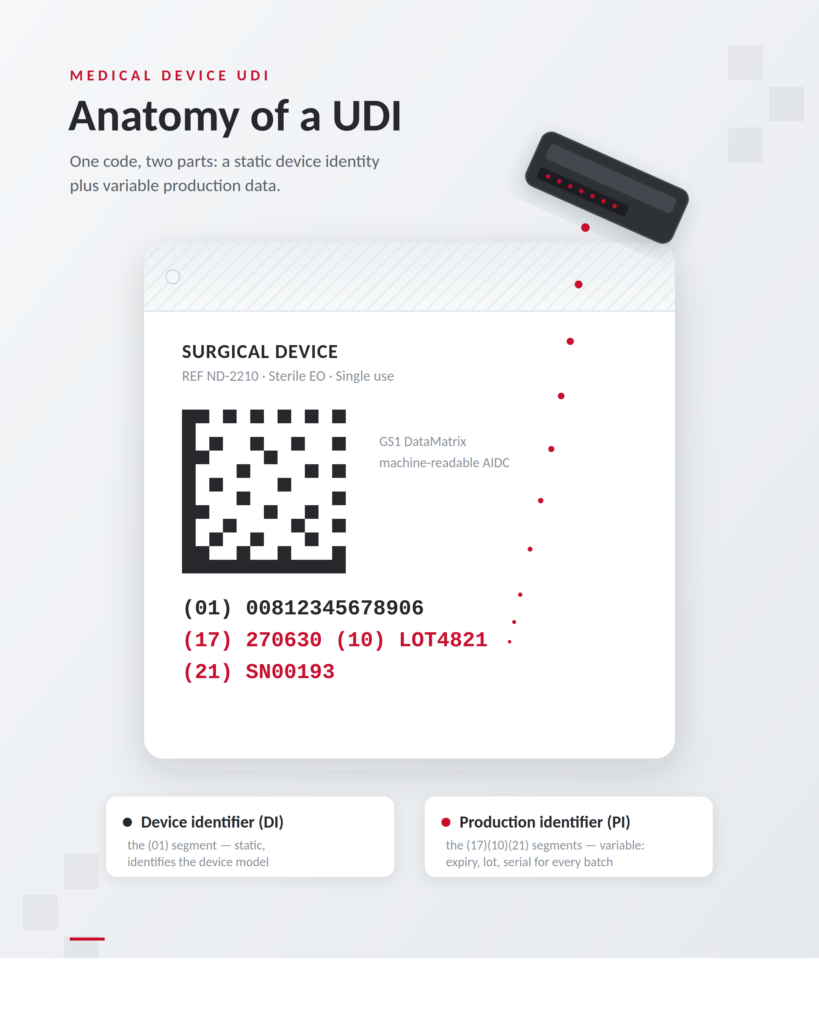
Unique Device Identification (UDI) is a global regulatory framework that requires medical devices to carry a standardized identifier on their labels and packaging, enabling traceability from manufacturing through patient use. Established by the FDA and now embedded in the EU’s MDR and IVDR regulations — with similar programs rolling out in markets worldwide — UDI supports faster recalls, accurate adverse event reporting, and full supply chain visibility. Each UDI combines a static Device Identifier (DI), which identifies the product model and labeler, with a variable Production Identifier (PI) containing lot number, serial number, and expiration or manufacturing dates.
Compliance places real demands on the production line. UDI must appear in both human-readable text and machine-readable form — typically a GS1-128 barcode or GS1 DataMatrix code — printed accurately and legibly at line speed on labels, pouches, cartons, and inserts. Codes must meet ISO print-quality grading standards to scan reliably throughout distribution, and reusable devices such as surgical instruments must carry a permanent mark on the device itself that survives repeated sterilization. Substrates ranging from Tyvek and foil lidding to plastics, glass, and coated board mean no single technology fits every application.
That’s where the right coding and marking equipment becomes essential. Thermal inkjet, continuous inkjet, and thermal transfer overprinting handle variable data on packaging at high speed, while laser marking delivers permanent, sterilization-resistant direct part marks. Paired with vision inspection to verify every code and seamless integration with labeling and ERP systems, a well-designed marking solution turns UDI compliance from a production bottleneck into a reliable, automated part of your line — keeping you audit-ready in every market you serve.
The Norwix Solution
Norwix helps manufacturers prepare for Sunrise 2027 by providing industrial printing systems capable of producing high-quality 2D codes in demanding production environments. Our TIJ and Piezo based platforms are well suited for applications where clean code formation, high-speed output, variable data, and easy integration are essential. From packaging lines and case coding to web printing and specialty production environments, Norwix gives customers a practical path to start printing the types of codes required for the next generation of retail and supply chain identification.
Our systems can print QR codes, GS1 DataMatrix codes, barcodes, alphanumeric text, lot codes, date codes, graphics, and other variable content directly onto production materials. Combined with Norwix Vega software, customers can manage variable data, serialization, batch tracking, database-driven print jobs, and integration workflows that are essential for modern product identification.
GS1 Digital Link turns the package into a bridge between the physical product and the digital world. Norwix provides the printing technology that helps put that bridge on the package clearly, reliably, and at industrial speed.